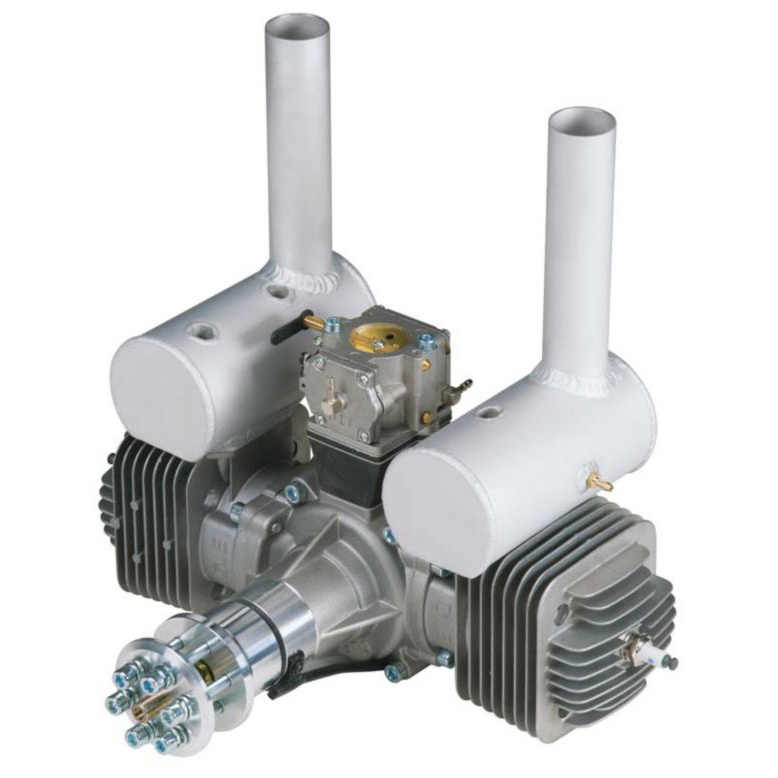
DLE-170 170cc Twin Gas Engine with Electronic Ignition and Mufflers
The DLE-170 engine is a high-performance gasoline-powered engine that delivers reliable and efficient power for model airplanes. Its key features include:
Displacement: 170cc
Power output: Up to 17 horsepower (HP)
Electronic ignition system: Provides easy starting and reliable operation
Mufflers included: Reduces noise levels for quieter operation
Compact and lightweight design: Ideal for use in a wide range of RC aircraft models
High-quality construction: Made from durable materials for long-lasting performance
Additionally, the DLE-170 engine is designed for easy maintenance and repair, with accessible spark plugs and other components that are easy to replace if needed.
Overall, the DLE-170 170cc Twin Gas Engine with Electronic Ignition and Mufflers is an excellent choice for hobbyists and professionals alike who are looking for a powerful and reliable engine for their model airplanes.
Description
The **DLE-170** engine is a high-performance, **170cc** gasoline-powered, twin-cylinder engine that delivers reliable and efficient power for model airplanes. It's an excellent choice for hobbyists and professionals looking for a powerful and reliable engine for their RC aircraft.
Its **Electronic Ignition System** provides easy starting and reliable operation, while the included **mufflers** ensure quieter performance. The engine is built with a compact and lightweight design, ideal for use in a wide range of RC aircraft models, and features high-quality construction for long-lasting durability.
Additionally, the DLE-170 is designed for easy maintenance and repair, with accessible spark plugs and other components that are easy to replace if needed.
Key Features
- Three crank bearings, simple design for lighter weight
- Double V-type reed valves, bottom induction
- **Automatic electronic ignition**
- Customized carburetor
- Special aluminum alloy crankcase and advanced **CNC machining**
- High quality sealed bearings
- **Horizontally opposed twin cylinders** for low vibration
- High power-to-weight ratio
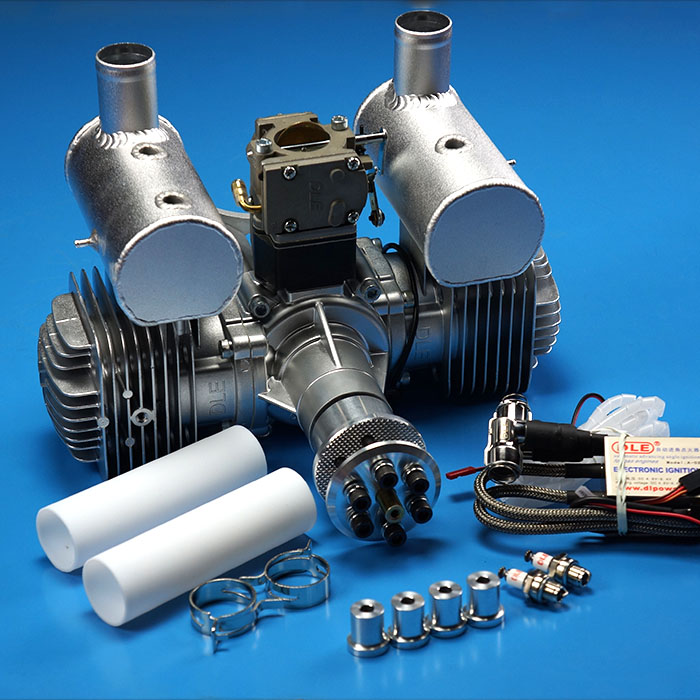
- Includes mufflers and mount


Specifications
| Stock Number | DLEG0170 |
|---|---|
| Displacement | 170 cc (10.37 cu in) |
| Bore | 2.05 in (52 mm) |
| Stroke | 1.57 in (40 mm) |
| Weight | 9.06 lbs (4.11 kg) |
| RPM Range | 1,100-9,000 |
| Output | 17.5 hp @ 9,000 rpm |
| Requires | Gasoline, oil, ignition battery & propeller |
| Suggested Propellers | 30 x 12 & 32 x 10 |
Technical Data & Requirements
| Ignition Battery | 4.8-6.0V NiCd or NiMH, 6.6V LiFe or 7.4V LiPo pack (LiPo or LiFe use requires voltage regulators.) |
|---|---|
| Compression Ratio | 9.5:1 |
| Gasoline/Oil Mix | 30:1 |
| Replacement Spark Plug | NGK CM6 (DLEG5510) or equivalent |
| Weights (individual) | Engine: 7.83 lbs (3,550 g); Exhaust (2): 7.05 oz (200 g); Ignition: 5.64 oz (160g |
| Includes | Electronic ignition, mufflers, mount, spark plugs, gaskets, bolts, machined aluminum standoffs, throttle arm extension & mounting template |
Start-up Procedure
- Close the **choke** and turn on the **ignition**. Advance the throttle to full position.
- Briskly flip the prop through compression until the engine fires and then dies. (May take a few more flips if stored for a long period.)
- Open the choke and briskly flip the prop through compression. Advance the throttle to very slightly above the idle position. The engine should start in just a few flips.
- For **hot starts**, open the choke, advance the throttle to very slightly above the idle position, and turn on the ignition. Briskly flip the prop through compression.
Safety Instructions
- **WARNING:** This gasoline engine is not a toy. Serious injury or damage may result from improper use.
- Before each use, carefully inspect the engine assembly, propeller, and airframe for loose screws and nuts. **We highly recommend using Loctite 242** on all screws and nuts during installation to prevent them from coming loose.
- **CAUTION:** If you plan to break in or test the engine on a test stand, it must have good shock-absorbing equipment to prevent potential damage from excessive vibration. **Mounting the engine on an airplane is the best way to break in the engine.**
- When running the engine, **never allow anyone, including yourself, to stand in front of or to the sides of the propeller’s rotating plane.** Always stand clear of and behind the propeller. Anyone near the engine should wear protective eyewear. Do not wear loose clothing near the engine or propeller.