Abstract: This paper elaborates on the important applications of hyperspectral imaging technology in the field of environmental monitoring. From water quality monitoring, atmospheric monitoring to ecological environment monitoring, the unique advantages, application methods and challenges of hyperspectral imaging are analyzed, and its future development trend is prospected.
I. Introduction
With the increasing prominence of environmental problems, accurate and efficient monitoring of the environment has become a top priority. Hyperspectral imaging technology, with its high spectral resolution and multi-band information, provides a powerful tool for environmental monitoring. It can obtain detailed spectral characteristics of target objects and provide a scientific basis for environmental quality assessment and pollution control.
II. Overview of hyperspectral imaging technology
(I) Principle
Hyperspectral images are composed of many continuous narrow-band images. By measuring the reflection, radiation and other characteristics of the target at different wavelengths, the spectral characteristic curve of the target is obtained. These curves contain the physical and chemical information of the target and can be used to identify and analyze different environmental elements.
(II) Characteristics
High spectral resolution: can distinguish subtle spectral differences and accurately identify different substances in the environment.
Multi-band information: contains a large amount of band data, which can fully reflect the characteristics of environmental targets.
Combining spatial information with spectral information: not only can the location of environmental targets be determined, but also their composition and state can be deeply understood.
Non-contact measurement: monitoring can be performed without damaging the environment.
III. Application of hyperspectral images in environmental monitoring
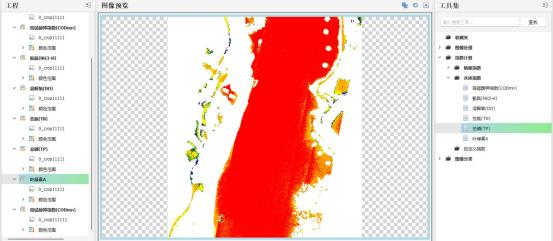
(I) Water quality monitoring
Pollutant detection: It can detect various pollutants in water, such as heavy metals, organic matter, nutrients, etc. Different pollutants will have unique spectral responses at specific wavelengths. By analyzing hyperspectral images, the types and concentrations of pollutants can be accurately identified.
Algae monitoring: The growth of algae will cause changes in the spectral characteristics of water bodies. Hyperspectral imaging technology can monitor the distribution and growth status of algae in real time, providing support for water bloom warning.
Water quality evaluation: By integrating information from multiple bands, a comprehensive evaluation of water quality can be conducted, including indicators such as transparency, turbidity, and dissolved oxygen.

(II) Atmospheric monitoring
Pollutant concentration monitoring: It can monitor various pollutants in the atmosphere, such as sulfur dioxide, nitrogen oxides, and ozone. By analyzing hyperspectral images of the atmosphere, the concentration distribution and changing trends of pollutants can be obtained.
Aerosol monitoring: Aerosols have an important impact on the atmospheric environment and climate change. Hyperspectral imaging technology can identify different types of aerosols and monitor their concentration and distribution.
Greenhouse gas monitoring: Monitor greenhouse gases such as carbon dioxide and methane to provide data support for responding to climate change.
(III) Ecological environment monitoring
Vegetation coverage monitoring: By analyzing the spectral characteristics of vegetation, the vegetation coverage can be accurately calculated and the health of the ecosystem can be assessed.
Biodiversity monitoring: Different species have different spectral characteristics. Hyperspectral imaging technology can be used to identify and monitor biodiversity and provide a basis for ecological protection.
Land use change monitoring: It can quickly monitor changes in land use and promptly discover illegal occupation and ecological damage.
IV. Advantages and challenges of the application of hyperspectral imaging technology in the field of environmental monitoring
(I) Advantages
High-precision monitoring: It can provide detailed spectral information to achieve high-precision monitoring and analysis of environmental targets.
Large-area monitoring: It can quickly obtain environmental information over a large area and improve monitoring efficiency.
Real-time monitoring: It has the ability to monitor in real time and can promptly reflect changes in the environment.
(II) Challenges
Complex data processing: Hyperspectral images have a large amount of data and are difficult to process, requiring professional software and algorithms.
Environmental interference: In actual environmental monitoring, it is easily affected by factors such as weather and light, which reduces the accuracy of the data.
High equipment cost: Hyperspectral imaging equipment is expensive, which limits its wide application in the field of environmental monitoring.
V. Future development trends
Technological innovation: Continuously improve the resolution and accuracy of hyperspectral images, develop more advanced data processing algorithms, and improve the accuracy and efficiency of monitoring.
Multi-source data fusion: Integrate hyperspectral images with other environmental monitoring data, such as satellite remote sensing data and ground monitoring data, to achieve more comprehensive environmental monitoring.
Intelligent application: Combine artificial intelligence, machine learning and other technologies to achieve automatic analysis and processing of hyperspectral images and improve the intelligence level of monitoring.
Cost reduction: With the development of technology and the expansion of the market, the cost of hyperspectral imaging equipment is expected to gradually decrease, promoting its wide application in the field of environmental monitoring.
VI. Conclusion
Hyperspectral imaging technology has great application potential in the field of environmental monitoring. It provides new means and methods for water quality monitoring, atmospheric monitoring and ecological environment monitoring. Although there are still some challenges, with the continuous advancement and improvement of technology, hyperspectral imaging technology will play an increasingly important role in environmental monitoring and provide strong support for protecting the environment and achieving sustainable development.